
As MBA Mama heads into 2026 with renewed focus, we’re proud to introduce Candid Conversations - a new content series spotlighting the leaders behind some of the world’s top MBA programs. Through candid conversations with top MBA program leaders, we aim to demystify the MBA experience for ambitious women with children. Whether you want to use your business education to accelerate your career, increase your earning potential, expand your network and/or sharpen the managerial skills and business acumen needed to thrive at the highest levels, this content series will have something you can use.
We’re honored to launch this series with an interview of Chelsea Hann, Director of Admissions and Scholarship at Cornell University’s Johnson Graduate School of Management in New York. In a candid virtual conversation with MBA Mama’s CEO, Chelsea offers an inside look at what Cornell Johnson has to offer MBA candidates with a specific focus on ambitious women navigating motherhood, family and career. With a decade of experience at Cornell and nearly three years in her current leadership role, Chelsea brings deep institutional knowledge and a clear commitment to building inclusive, high-impact MBA cohorts.

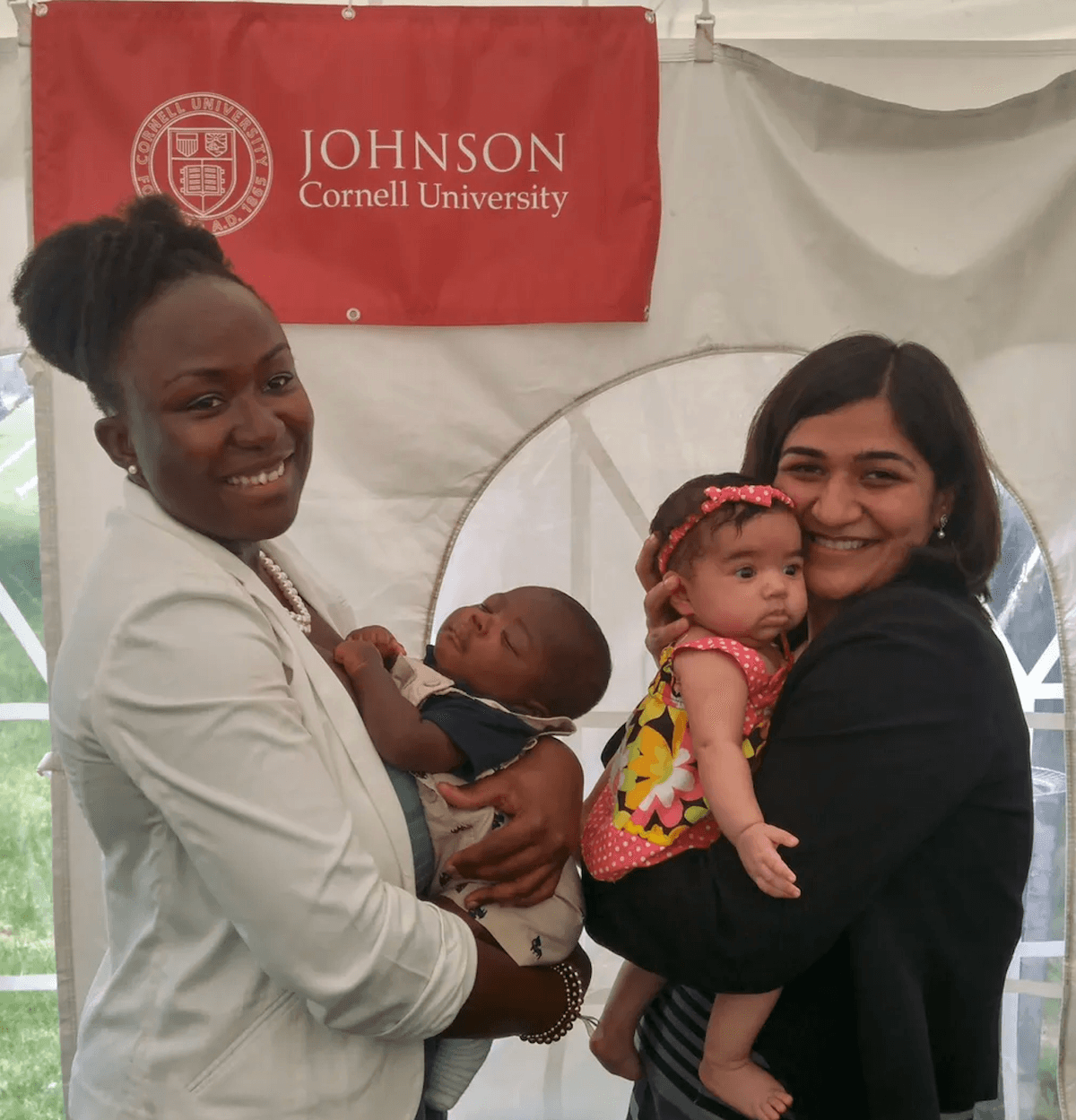
Chelsea holds a bachelor’s degree in Communication and Media Studies from Commonwealth University-Bloomsburg and a master’s degree in Educational Leadership and Administration from Lehigh University. Beyond her professional credentials, she is also a mother - an identity that informs her understanding of the real world challenges career moms face every day. That perspective is evident in Cornell Johnson’s ongoing efforts to champion gender diversity and advance gender equity within its MBA program. We were excited to see that Cornell has remained committed to the Consortium for Graduate Study in Management (CGSM) despite several high profile MBA programs leaving CGSM citing the current anti-DEI environment. Through thoughtful admissions practices, scholarship opportunities, and a culture of support, the school continues to position itself as a place where women can pursue leadership without compromise. Pictured below are two Cornell MBA Mamas from the class of 2016: Priscilla Akomaning and Jiajia (Kelly) Xu.
Divinity Matovu: Given that many MBA Mama members are mothers or caretakers, what resources or community support does Cornell Johnson’s full-time MBA program offer to students who bring children or family responsibilities into the MBA program?
Chelsea Hann: Cornell has a free 12 week virtual class on Zoom for expecting parents, new parents or those who are planning to become parents. It’s really open to everyone and it’s hosted by Cornell as a weekly evening zoom class. There are dozens of lactation rooms on campus. I think there's about 42 different lactation rooms throughout campus, and we have one here in the business school in Sage Hall. Cornell has a wonderful daycare center on campus by Bright Horizons. There is a child care grant that's available through Cornell that students can apply to and receive a stipend or some funding to help offset the costs of child care. Cornell also does a sponsored Care.com membership if a student wants to use that to look for in-home care or a nanny service or a shared daycare service. Cornell has student and family health care available.
We have lots of social events available for families and partners at Cornell and also at Johnson. We do a career fair actually for our MBA partners and spouses in August when our students start the program which is to help the partners and the spouses find work. They can also get help finding daycares, babysitting services or school information to help enroll their children if they have school age children in some of the local schools here in the Ithaca area. We have a really comprehensive set of resources and we support parents in the program. Everything from housing, school, daycare, and health care.
Divinity Matovu: Cornell Johnson allows students to design customized immersions and electives. Can you share your perspective on how this academic flexibility benefits parents or caregivers who need to balance school and family?
Chelsea Hann: The flexibility of the curriculum at Johnson is one of my most favorite things about this MBA program. It's super unique. It's about a full semester that students can take anywhere on campus that they want to. There's some classes they can take in New York City. There's study abroad. There's electives at some of our sister schools in the College of Business. So, it really is flexible and I think that's super important to be mindful of when you're thinking about moms in the program who are taking classes. You have the opportunity to really blend and mix your coursework and sample classes from this exceptional buffet of learning opportunities throughout campus. It number one adds some potentially unique and different content to your degree, but also it gives you the opportunity to be more flexible in planning your class schedule around your child care schedule.
Divinity Matovu: Anecdotal feedback from some Johnson alumni suggests that smaller class sizes and a collaborative culture in Ithaca creates a supportive “family-friendly” vibe. How intentional is Cornell Johnson about fostering community, inclusion, and support for nontraditional students, specifically parents?
Chelsea Hann: I don't think we could be more intentional. This is something that we really focus on as part of the MBA experience here for our students. We very much understand that MBAs happen for people at various phases of life, right? So the range of work experience is anywhere from maybe two to three years of experience all the way up to 10 plus years of professional experience. So people are in really different stages of life throughout that time period. That means we think a student's family, if they have one or if they're planning to have one in the near future, it's so important to help support them throughout this experience. A lot of our students rely on the support of their families and their partners as they go through the MBA. So, we really try to include partners and families in this MBA experience at Johnson just as much as our students. I have a seven-month-old and I can speak firsthand to the support that the program and the community provides for anyone with children or anyone planning to have children.
The social events and connections to different resources and the help Cornell provides in terms of child car, scholarships, or even helping connect them to a pediatrician or a healthcare organization or a lactation consultant if that's what they need. We have the ability to really support and provide resources and connections to students as they go through a very new experience in business school while balancing and caring for their families in a totally new city with different peers and a new network. It's so important to have a group of people and a peer set that you can rely on and count on to support you as you go through that experience.
It's so important that you find a MBA program that has people there that can support you and point you in the right direction if you are thinking about leaving your comfort zone, the city where you're coming from, so your family, your friends, your resources, your doctor's offices, etc. Two years can go by in the blink of an eye if you're in the right place, but if not two years can feel like a lifetime if it's a struggle. So it's important that you find a place that you feel at home and where people really have your back.
Divinity Matovu: Financing an MBA is a real concern for many mothers balancing family obligations. Approximately 30% of Johnson students receive merit-based scholarships, and there are full-tuition fellowship opportunities. What should prospective students who are parents know about financing options?
Chelsea Hann: Financing is so important and there are a number of different financing options available. I think applicants often go to a tuition page of a website and they get really scared by the price tag and yes it is high and it's high because the ROI is high so it is worth it. But the MBA can be affordable and it is doable. Applying for merit-based scholarships through admissions is one avenue of receiving funding and helping to finance the degree. At Cornell, we have full tuition merit-based scholarships such as the Park Fellows Program. Our merit-based scholarships range anywhere from 10% all the way up to full tuition. That is just one way to help finance the degree. There are outside scholarships as well. We are one of the few programs I've noticed that actually has a direct link on our website to outside scholarships that students can apply for. It has a very very long list of the most popular outside scholarships that our students have used in the past to help fund the degree. So, that's a fantastic resource that I would advise applicants to look at when they're thinking about how to finance the degree.
The other thing I would say is think about things that you could do during your program to help offset the cost. So, TA’ing for a class or working in a paid student position in the program such as ambassador positions, student interviewing positions, and even leadership roles on campus - some of those in more recent years have become paid positions. That can also help offset the cost of your program while you're enrolled. Cornell’s child care grant is a really important resource as well.
When you're thinking about potentially borrowing and having to take out a loan, you can increase your loan amount by the overall cost of attendance and your cost of living if you have dependents or wanted to participate in an international study trip or something like that. Overall, the ROI is worth it and the MBA is affordable. You just have to be thoughtful. My final piece of advice is to start financial planning for the MBA early and and you'll be better off.
Divinity Matovu: Johnson’s full time program offers international treks, global learning opportunities, and immersive experiences. For candidates with children, how does Johnson accommodate or advise around these opportunities to ensure they remain accessible and realistic?
Chelsea Hann: Like any other student, you have to be strategic and intentional about how you choose to invest your time and how you choose to customize your program. As an example, taking a full semester abroad with a little one might be more challenging or more difficult than a seven to 10 day international study trip. That might be more manageable depending on your child care situation, and you still have an opportunity to get some global exposure if that's really high on your priority list for MBA study. If a 7-day international study trip or an international trek is also really difficult depending on your child care situation or your little one, you might find that maybe doing a weekend elective at our New York City campus is a way to get outside of Ithaca and do something a little bit different and take some new classes.
Divinity Matovu: What is the biggest mistake you’ve seen candidates make on applications during your career as an admissions leader?
Chelsea Hann: In my nearly 10 years, I have seen thousands of applications and with that, I've seen thousands of mistakes. I've seen lots of errors. So I have great tips and some feedback here. I think the first thing I would say is generally anything that causes more questions for the person reading your application or the admissions committee is not a good thing, right? And so what that really means is: do not leave any information blank. If there are questions that are not answered, if there are fields in our application, there are things we're asking for because it's helpful for us to get to know you and to know your full story and really paint the full picture and connect all of the dots. So, when you leave information blank and it's missing, even if it's optional, that to me is a missed opportunity.
The other example would be if your dates don't align, right? What you put on your resume and your work experience should not be different from what you put in the application section for work history. That will cause questions for the person reading your application. So, you want to make sure your application is consistent, your dates align, and you tell the full story of how you got to where you are today and where you hope to be. The second thing I would say is applications that are rushed. So essays that are only a few sentences, essays that are clearly not proofread and again, questions that are left blank. I’ve seen candidates putting the wrong school in an essay. You'll hear that a lot from different programs and you'd be surprised how often applicants do it, but that type of error more than anything shows a lack of effort.
Divinity Matovu: Oh my gosh!! I cannot believe candidates are making such careless mistakes in their MBA applications. So many unforced errors.
Chelsea Hann: Yes and so if you're not taking this seriously putting your Johnson application forward, I don't take you seriously as a candidate if you name a different school in the application. How much thought and how much effort have you put into putting this application together? And then the other thing I would say is the admissions interview for me can really make or break a candidate's application. If they haven't tested the audio or the microphone and they're doing a virtual interview and we spend a third of our time together helping troubleshoot their technical issues, that's a missed opportunity. If you're not prepared for the questions or if you're reading off of a script - all of those things to me are red flags that can really add up and impact somebody's candidacy.
Divinity Matovu: What advice would you offer to ambitious moms considering a full-time MBA program?
Chelsea Hann: The advice I have as a new mom myself is that this will never fit into your life perfectly. There will never be the perfect or the right time to do this. So, if you're waiting for that break where you can take two years off to do the MBA or you're waiting for the time when you feel like "Yeah, now I feel like this will fit in to my situation” then all you're going to do is continue to push business school farther and farther out and it's just not going to happen. There will always be things that seem like they're higher priority and there will always be things that seem like you have to do them first before you can do the MBA. In the grand scheme of things, two years is a short period of your life. The ROI of this degree will be worth it for your family. And this is doable. You can make it work if you find the right program with the right community, the right resources, and the right support. You can make it work for yourself and your family.